What Is A Forward Deployed Engineer?
Forward deployed engineering is having a moment. Every AI company suddenly wants FDEs, and the reason is simple. With agents, context is the whole job. You can't build a good agent for a workflow you've never watched happen. So the FDE sits inside the client's company and works next to their team. Not on a discovery call, not over a recorded demo. In the building, watching the actual work, so they understand the problems people run into on a normal Tuesday.
What the job actually is
In revenue cycle management, that embedding is what makes the difference. You sit inside a practice or a billing operation and map the workflows that actually move money. The repetitive ones. The ones where a claim sits in a queue for eleven days because nobody owns it. The work itself comes down to three things: running the assessment, building evals so you know the agent is doing the job, and handling deployment. None of these are one and done. Every design decision you make early has consequences that show up months later, so you make them carefully.
Moving Past automation, toward a system that improves
The real function of an FDE is understanding which outcomes actually drive the business. We want to get past building one-off automations and start building an operating system that gets better over time. This creates a self-improving revenue recovery system and not just one off automations.
That said, plenty of jobs don't need an operating system. A lot of work is a handful of tool calls, and an automation is the right answer. Part of the job is knowing the difference and not over-building something that wanted to stay simple.
The Revenue Integrity Framework
At ClearCycle we run our FDE interviews through what we call the Revenue Integrity Framework. It keeps the questions pointed at money instead of feature wishlists. A few of the ones we always ask:
Understand the actual work. Walk me through what happens from the moment a denial arrives to the moment it's resolved or written off. Who touches it? In what order? Where does it wait? This is where evals earn their keep. Watching the real path is how you find the gaps where an agent would miss what a human is actually looking at.
Find the revenue leaks. What percentage of denials never get worked? Be honest. Not the target, the reality.
Understand the data. If I ask for a single patient's full status, claims, authorizations, balance, last interaction, how many systems do I have to open to answer?
Separate judgment from rules. For each step in the workflow, does it need judgment, or is it following a rule? If a new hire had a written checklist, could they do it?
Treat the agent like a new hire
Treat every agentic system like you're onboarding a junior member of the team. You wouldn't hand a new analyst the keys on day one with no checklist and nobody reviewing the work. An agent is no different. It earns trust by doing the small jobs well first.
This is also where the 10-20-70 rule from BCG holds up. Ten percent of the value is the algorithm, twenty percent is the tech and data, and seventy percent is people and process. At the end of the day, its about change management to get the system going and implemented. This is where On an agentic project that ratio holds. You can ship a technically perfect agent and watch it die because the team kept working the old way. Most of the success isn't the model or the code. It's the people adoption piece.
Evals, and why we built the CYCLE framework
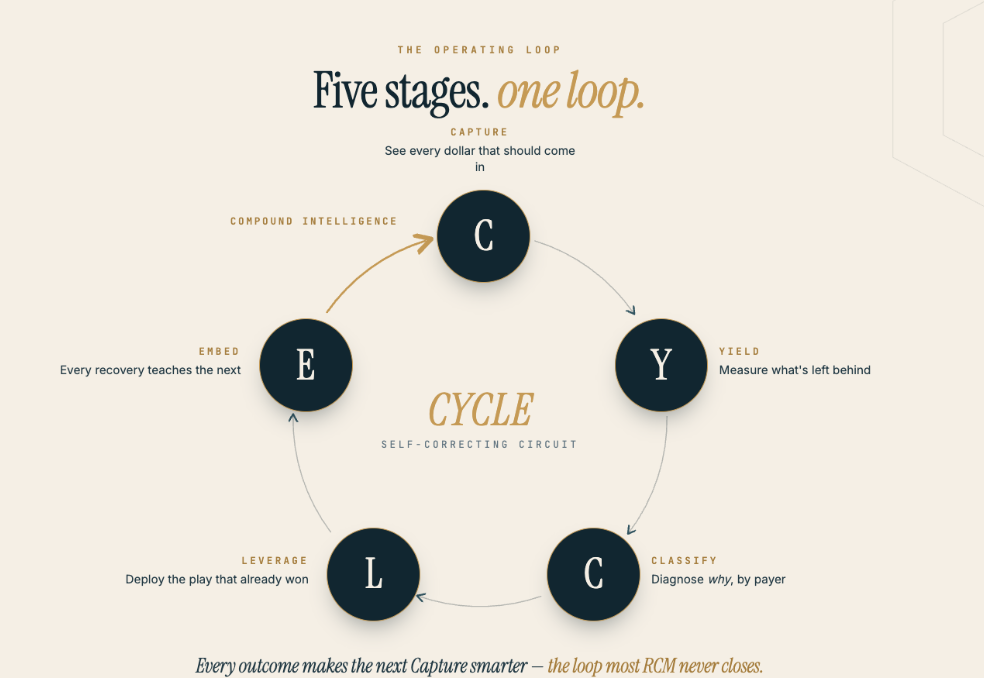
Without good evals you're guessing at what success looks like. Evals are also how an FDE builds something that generalizes instead of turning into one more consultant who leaves and takes the knowledge with them. The difference between an FDE and a consultant is a system. At ClearCycle, that system is the CYCLE framework, which is how we capture value across every client we work with.
Why technical PMs are built for this
I think technical product managers are the best fit for this role. They already spend their days understanding customer problems and turning needs into solutions. And a big part of FDE work is exactly that last step: taking something technical and explaining it to a practice owner who doesn't care about the architecture, only about whether the money shows up…
(This is Part I of our series of Forward Deployed Engineering in revenue cycle management)
Where and How to Host Your AI Agent Harness in RCM
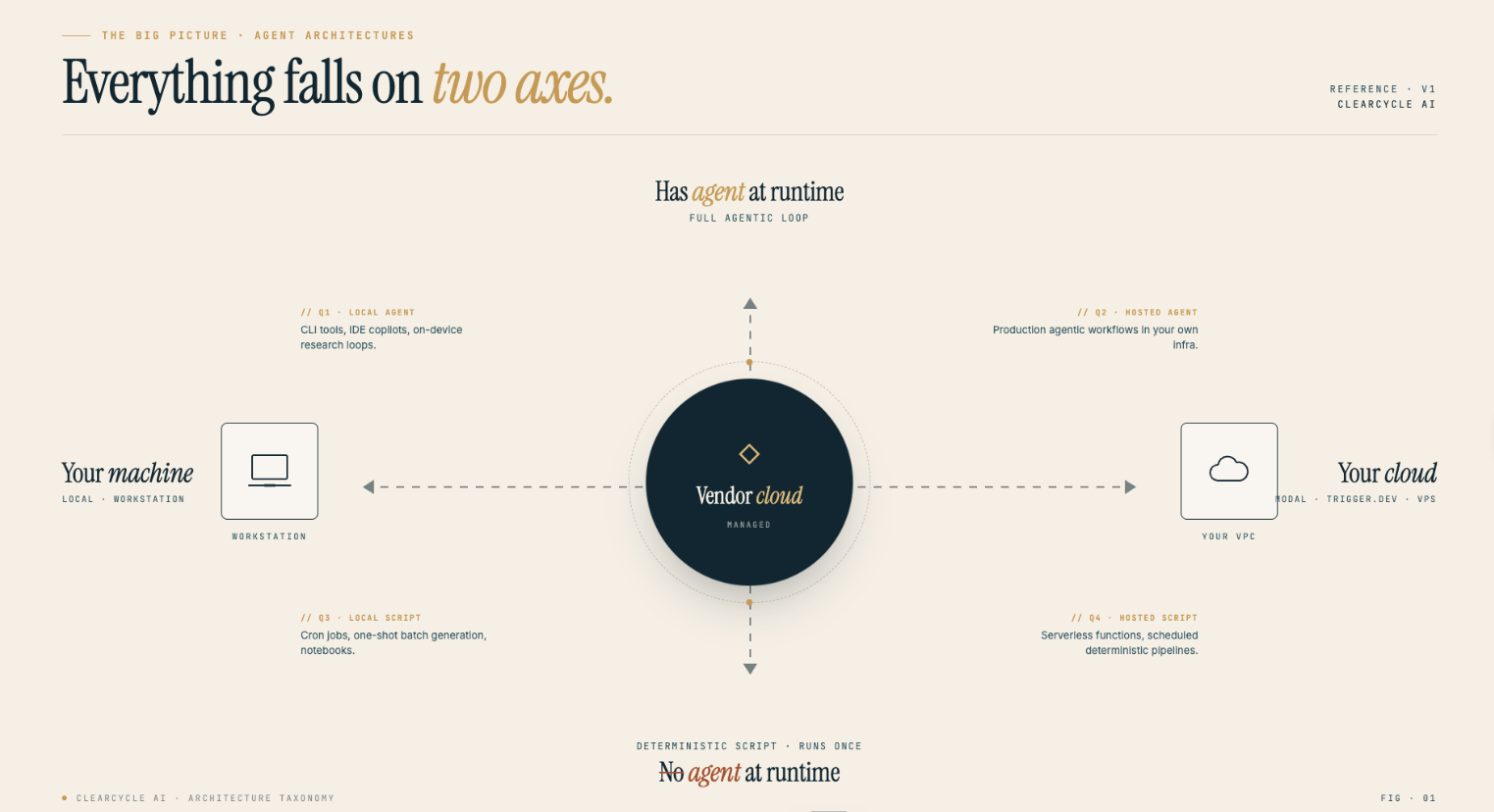
Deploying agentic AI, which really means autonomous AI in large scale healthcare systems is really about managing affordances. The incredible unlocks with the progress of AI have the potential to create a real change in the healthcare system to make it more efficient and increase net revenue. What most people are after nowadays, when they talk about creating agentic systems is creating systems where AI can run autonomously to make decisions, and execute long running tasks end-to-end. When considering different AI agent harnesses, the thing that makes healthcare different is the HIPAA and PHI considerations.
Generally, you will have to sign a BAA with an frontier model company if you are using their LLM (think OpenAI or Anthropic’s models). This prevents these model providers from using your data to train their models. There are cloud providers that host these models in a HIPAA compliant way, so thats the good news. They will provide dedicated infrastructure for you. We use AWS Bedrock for our deployments. It allows you to use the Claude Opus models and even Nvidia’s new Nemotron models. Azure gives you access to the OpenAI models in a cloud enterprise-ready environment. What’s surprising is its not actually that much more expensive to use these models through the enterprise plans, rather than going directly with an individual consumer subscription. Many healthcare systems will already be running on Azure, and OpenAI has already developed a bit of a headstart with healthcare practices. They also have a small hosting cost associated with their usage. Bedrock is usually the fastest to approve and their BAA process is the shortest.
If you do decide to utilize your own enterprise model, you can host it on Amazon Bedrock. There is a growing need for automation, intelligence, and interoperability in healthcare because the complexity of reimbursement continues to increase. There are moves that certain payers are making like UHG actually cutting out prior auth requirements for certain procedures, but he fact remains that RCM continues to get more complicated and require more piping to make data interoperable between different systems. Future-proofing your RCM system for this uncertain future requires an organization to take measured steps to understand where the model providers are going with their business roadmap. Anthropic is making some real investments in healthcare and especially within tech around prior auth, so take note. AI models are eating the world, but there are still many moats. Healthcare remains a local business so its especially important to use forward deployed engineering to suss out workflow inefficiencies that impact patient care and collections.
Especially now with the PE firms swooping in and consolidating smaller specialty RCM groups, the need to create efficiencies on an AI-enabled chassis are just increasing. At ClearCycleAI our goal is to be outcome focused. We help healthcare practices recover revenue without increasing headcount. The is an ever expanding field we’re in. Some would call it an AI boom which is catalyzing a real industrial revolution. As a result, there is a lot of confusion on what steps to take and what technologies to adopt to future proof yourself. This is where we can help. Please reach out to us for a FREE assessment on where your company stands. We’re here to help! Email hello@clearcycle.ai for more information.

Workflows, Agents, and Tools - How to make sense of AI Agents in Revenue Cycle Management
It All Begins Here
How AI actually works inside your practice .. in plain English.
If you've been hearing about "AI agents" for your healthcare practice and wondering what's actually under the hood, this is a good intro. There are three pieces that make an AI agentic workflow work. We’ll show you how they fit together to recover denied claims, answer your phones, and handle the busywork your team would rather not do.
Workflows: the playbook
A workflow is just a standard operating procedure(SOP) the same kind you already write for your front desk. The only difference is that it's written in a plain text format called markdown, so an AI agent can read it. If your denial appeals process today lives in someone's head or a half-finished Word Doc, a workflow drags it into the light. Step one: pull the EOB. Step two: identify the denial code. Step three: check the filing deadline. Step four: draft the appeal letter. And so on..
A good workflow is boring on purpose. We keep each one under 500 lines. Anything longer gets broken into smaller workflows or moved into a skill (more on that in a minute).
Agents: the worker
An agent is what reads the workflow and executes it. Think of it as a very diligent new hire who reads the SOP, follows it exactly, and never forgets a step.
Unlike a traditional software tool that only does what it was hardcoded to do, an agent can reason. If the workflow says "check the payer portal and escalate if the auth is stalled more than five days," the agent can actually make that judgment call.
The agent's operating rules live in a file called Claude.MD. That's where we put the high-level instructions - how to talk to staff, when to escalate to a human, which clinic this is, what's in bounds. What’s out of bounds. Anything more specialized or is redudant gets moved into a skill.
Tools: the hands
Workflows tell the agent what to do. Tools are how it actually does things. These are small scripts that let the agent take real action; submit a form on a payer portal, send an SMS reminder, pull an EOB from your EHR, post a payment to the ledger. The agent picks up a tool the same way a nurse grabs a thermometer: when the workflow calls for it. This is where tools like OpenClaw and Hermes Agent have been gaining traction.
Memory: what it remembers
An agent without memory forgets everything the moment you close the tab. Not useful. So we build persistent memory; a running knowledge base that remembers this payer's quirks, this patient's history, and last month's denial patterns.
Some teams use wiki-style memory systems .. Andrej Karpathy's personal wiki is a well-known example, and tools like Obsidian work the same way. For a clinic, we build memory that's specific to your practice: your payer mix, your appeal templates, your scheduling rules, the edge cases your staff already know by heart. We’re building our own at ClearCycle that includes many of the elements of Autoresearch as well as some very specialized reasoning layers which look at payer reimbursement history.
Skills: imported expertise
A skill is a pre-packaged set of instructions for a specialized task. We maintain skills for things like:
Prior authorization submissions
Denials and appeals drafting
No-show recovery sequences
After-hours call routing
When the agent hits a task that needs deep expertise .. like drafting an appeal for a specific CPT code denial .. it pulls in the relevant skill the same way a primary care doctor calls in a specialist consult.
Here's the part that makes skills powerful: they can self-improve. Every skill includes a section where the agent records what worked and what didn't. Over time, your appeals skill gets better at your practice .. it learns which language a particular payer responds to, which documentation they want attached, which filing windows apply in your state. This is where we’ve built in a predictive engine to be able to test assumptions on payment likelihood.
This is what people mean when they say AI systems compound. A deterministic workflow does the same thing forever. A skill-based agent gets sharper every week and self-improves.
The self-improvement loop
Put it all together and you get a loop:
Agent reads the workflow.
Agent uses tools to execute it.
Agent logs what happened in memory.
Agent updates the relevant skill with lessons learned.
Next time around, it's a little better.
Multiply that by every denial, every appeal, every phone call .. across every clinic we work with .. and you get a system that quietly improves in the background while you run your practice.
How you actually talk to it
Interfaces matter. An agent you can't reach is useless.
Some teams chat with their agents through Slack, Azure, and other HIPAA-compliant channels .. you send a message like "what's the status on the Humana appeal for patient 4472?" and get a real answer back. At ClearCycle, we build a managed dashboard for each practice. That's where you see revenue cycle status, open denials and appeals, recovered dollars, and anything the agent flagged for human review.
You don't learn a new tool. You open the dashboard in the morning, see what the agent did overnight, approve or redirect, and move on with your day.
Why we still send a human
Here's the part most AI companies skip. Business context is what makes all the skills actually work.
I worked in the EHR space back in 2009, and one thing was obvious even then: every clinic is its own world. Your front desk workflow is not the same as the orthopedic practice down the street. Your payer mix isn't the same. Your staff's habits, your scheduling logic, the way your providers like their charts prepped .. none of it is the same.
A workflow system built for one practice doesn't transplant cleanly into another. It needs tuning. That's why we embed a forward-deployed engineer into every practice we work with. They sit with your team, learn your actual workflow (not the idealized one on paper), and build the agent around how you already run. The agent is only as smart as the context it has. Our job is to make sure it has the right context, at the right time, for your practice specifically.
That's the whole stack: workflows tell the agent what to do, tools let it do things, memory and skills make it smarter over time, and a dashboard keeps you in the loop.
If you're curious what this would look like in your office, reach out: hello@clearcycle.ai.